 blog
blog
Cost of Slab Leak Detection Services: 2026 Price Guide
Table of Contents
- What Drives the Cost of Slab Leak Detection Services
- Slab Leak Detection Methods: What You're Paying For
- How Long Does Slab Leak Detection Take?
- Does Homeowners Insurance Cover Slab Leak Detection?
- Detection vs. Repair Costs: Why the Two Numbers Differ
- DIY vs. Professional Slab Leak Detection
- Frequently Asked Questions
Last Updated: September 23, 2026
What Drives the Cost of Slab Leak Detection Services
The cost of slab leak detection services depends on home size, foundation type, and how hard the leaking pipe is to reach.
Property Size and Foundation Type
Larger homes mean longer pipe runs, which take more time to isolate. A single-story ranch is faster to test than a two-story home with multiple wet walls.
- Home size: More square footage means more pipe to test
- Foundation type: Post-tension and raised foundations change the approach
- Pipe material: Copper piping corrodes differently than PEX piping
- Age of the home: Older systems often have more than one leak candidate
Access Difficulty and Equipment Fees
Where the leak sits changes the job. A leak under an open hallway is easy to reach; one under a tiled bathroom, built-in cabinet, or load-bearing wall is not, and that access problem shows up in the quote.
Slab Leak Detection Methods: What You're Paying For
What you're paying for is a technician's ability to narrow a leak to a small area before anyone touches concrete. The method determines accuracy and cost.
Acoustic and Electronic Leak Detection
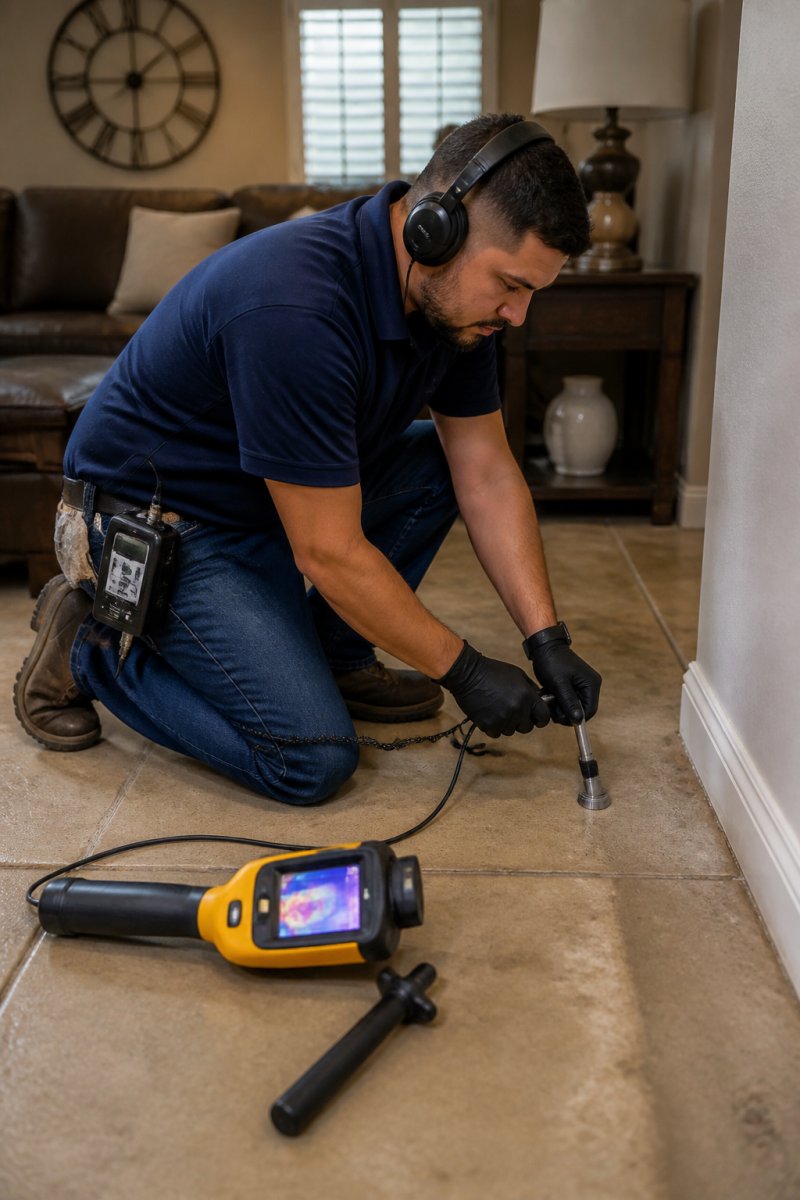
Acoustic listening equipment picks up the sound of water escaping a pressurized pipe. A trained ear with sensitive microphones on the floor can often pinpoint a leak within a few inches.
Thermal Imaging and Pressure Testing
An infrared camera reads temperature differences on the floor. A hot water line leak shows up as a warm patch, making thermal imaging fast and non-invasive.
How Long Does Slab Leak Detection Take?
A typical slab leak detection takes one to three hours for a straightforward case. Complex homes with multiple wet walls, post-tension slabs, or hard-to-access leaks can run longer, sometimes across two visits.
Here's the honest breakdown of where that time goes:
- On-site assessment and setup: 20 to 30 minutes
- Pressure and meter testing: 20 to 40 minutes
- Acoustic and thermal scanning: 30 to 60 minutes
- Confirmation and documentation: 20 to 30 minutes
Does Homeowners Insurance Cover Slab Leak Detection?
Homeowners insurance sometimes covers slab leak detection, depending on the cause and your policy. Most policies cover "sudden and accidental" water damage but exclude long-term seepage, poor maintenance, or normal wear on aging pipes.
How Adjusters Actually Read a Slab Leak Claim
An adjuster isn't asking "is there a leak?" They're asking three questions: Was the damage sudden and accidental or did it develop over time? Is the cause a covered peril or an excluded one like wear and tear? Is the documentation strong enough to separate covered water damage from excluded pipe deterioration?
What Your Claim File Needs to Succeed
Insurance claims succeed or fail on documentation. A vague "leak found under slab" report gives an adjuster nothing; photos, pressure test readings, the leak's exact location, and a clear cause description give them a file they can approve.
A complete detection report for claim purposes typically includes:
- Photos of the leak location and affected area, including the floor surface and any visible moisture or staining
- Pressure test and meter test readings, with before-and-after numbers showing the drop that confirmed the leak
- A written description of the cause, distinguishing sudden failure from gradual corrosion where the evidence supports it
- The leak's exact location, tied to a room or measurement so the repair scope can be verified
- A repair scope with clear line items, separating detection, pipe repair, and concrete or flooring restoration
The Claim Timeline After Detection
Most homeowners don't know what happens between "leak found" and "check in hand." The sequence usually runs:
- Detection report delivered, you receive photos, test data, and a written cause description.
- Claim filed, you submit the report and your policy number to your insurer, typically within the window your policy requires for prompt notice.
- Adjuster assignment, an adjuster is assigned and may request additional documentation or an independent inspection.
- Coverage determination, the adjuster approves, partially approves, or denies based on cause and policy language.
- Repair authorization, once approved, you schedule repair; some insurers require approval before work begins.
- Documentation of repair, keep invoices, photos of the opened slab, and receipts for restoration to support the final payout.
When Detection Isn't Covered
Even with a strong report, some claims fail because the policy excludes the peril. Common exclusions include:
- Gradual deterioration, pipes that failed from age, corrosion, or repeated freeze-thaw cycles
- Poor maintenance, documented history of ignored leaks or deferred plumbing repairs
- Earth movement, slab movement from soil conditions, which many policies exclude separately
- Faulty workmanship, leaks traced to a prior repair or installation error
Detection vs. Repair Costs: Why the Two Numbers Differ
Detection and repair are two separate jobs with two separate price structures. Detection is diagnostic: you pay for a technician's time and equipment to locate a problem. Repair is construction: labor, materials, and restoring whatever gets opened up.
| Stage | What You're Paying For | Cost Driver |
|---|---|---|
| Detection | Technician time, equipment, diagnostics | Access difficulty, home size |
| Repair | Labor, materials, concrete work | Repair method, pipe length |
| Restoration | Flooring, patching, finish work | Damage extent |
Rerouting vs. Tunneling: How the Repair Method Changes the Number
Once the leak is located, the repair method is the single largest swing factor in total cost.
| Method | Slab Intact? | Flooring Intact? | Typical Cost Position |
|---|---|---|---|
| Rerouting | Yes | Yes | Lower to moderate |
| Tunneling | Yes | Yes | Moderate to higher |
| Slab break-through | No | No | Highest (includes restoration) |
The Post-Detection Timeline: What Happens Between "Leak Found" and "Repair Started"
Most guides stop at the cost comparison. The part homeowners lose sleep over is the gap between the detection report and the first day of repair. The realistic sequence:
- Detection completed, you have a report with the leak location, test data, and a recommended repair method.
- Repair quotes gathered, get at least two quotes that specify the method (reroute, tunnel, or break-through) and break out detection, repair, and restoration separately.
- Insurance decision, if you're filing a claim, this step can add days to weeks depending on the adjuster's schedule and whether an independent inspection is required.
- Repair scheduled, once approved or self-funded, the repair is scheduled. Tunneling and break-through jobs often need permits, which adds time.
- Repair performed, rerouting is often a single-day job; tunneling and break-through can run multiple days.
- Restoration, flooring, patching, and finish work follow, sometimes by a separate contractor.
Why Separating the Numbers Protects You
A bundled quote hides that detection is a fixed diagnostic cost while repair is a variable construction cost. With one number, you can't tell whether you're paying a premium for detection, repair, or both. Separating them lets you compare detection quotes against each other and repair quotes against each other, the only way to know if an offer is competitive.
DIY vs. Professional Slab Leak Detection
If you suspect a slab leak, the fastest path is a professional inspection that combines multiple detection methods. California Leak Detection Specialists is a family-owned, licensed, bonded, and insured team (CSLB License #741886) that handles detection, documentation, and repair under one roof. We provide clear reports, photos, and repair information built for the claims process.
Frequently Asked Questions
Will insurance pay for a slab leak?
Most homeowners insurance policies cover sudden, accidental water damage from a slab leak, including damage to personal belongings and some structural elements. However, the detection service itself is often treated differently from the resulting damage. Policies typically exclude gradual deterioration, pipe corrosion, and lack of maintenance. Review your specific policy language and document everything with photos and a written report from a licensed leak detection provider before filing a claim.
How long can a slab leak go undetected?
A slab leak can go undetected for weeks or even months because the pipe is buried under concrete and water may seep silently into the soil or foundation. Early warning signs include unexplained spikes in your water bill, the sound of running water when no fixtures are on, warm spots on the floor, and cracks in walls or flooring. Catching it early limits water damage and foundation repair costs substantially.
Does the cost of detection include the actual repair of the pipe?
No. Detection and repair are billed separately. The detection fee covers the on-site assessment, equipment use, and a written report identifying the leak location. Repair costs depend on the method chosen. Rerouting the pipe through walls or the attic avoids breaking concrete, while tunneling under the slab accesses the pipe directly. Ask your provider for a clear breakdown of both phases before authorizing work.
What methods do professional plumbers use to detect a slab leak?
Professionals use several slab leak detection methods depending on the situation. Acoustic listening equipment picks up the sound of escaping water. Electronic leak detection traces moisture patterns. Thermal imaging and infrared cameras reveal temperature differences caused by hot water leaks. A hydrostatic pressure test confirms whether the leak is in the supply or drain line. Most providers combine two or more methods to pinpoint the leak with minimal access.
A slab leak rarely announces itself, and the longer it runs, the more damage it does to your foundation and your flooring. Getting it located accurately the first time saves you from exploratory demolition and a denied claim. California Leak Detection Specialists handles the full process, from acoustic and thermal detection to insurance-ready documentation and repair. Call (951) 278-8999 to schedule an inspection and get a clear answer about what's happening under your floor.